

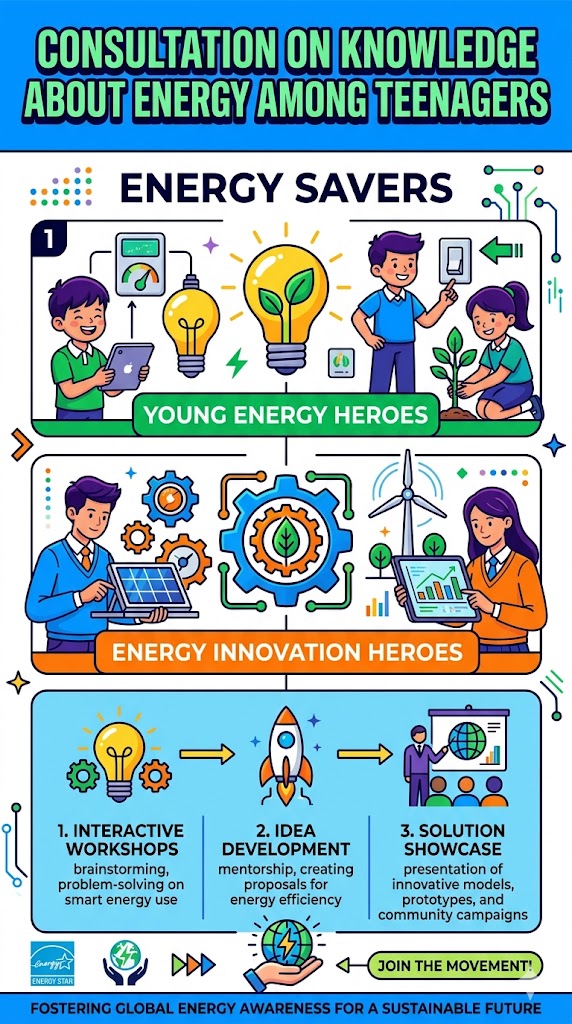
EXECUTIVE BRIEF: CONSULTATION ON KNOWLEDGE ABOUT ENERGY AMONG TEENAGERS
1. Executive Summary
The transition toward a sustainable, energy-efficient nation depends heavily on the literacy and active engagement of the next generation. This consultation initiative focuses on assessing, building, and channeling energy literacy among Malaysian youth. By framing teenagers not merely as consumers but as active stakeholders, this initiative aims to cultivate a culture of sustainability.
This program bridges the gap between theoretical knowledge and practical application through structured pathways, preparing youth to advocate for smart energy habits under the overarching banner of national energy transition and efficiency awareness.
2. Problem Statement
While today's teenagers are highly aware of global climate conversations, a gap remains regarding localized energy literacy:
-
The Literacy Gap: Many youths struggle to connect daily behaviors with broader energy infrastructure demands, utility costs, and national sustainability milestones.
-
Lack of Structured Frameworks: Practical guidance on implementing energy-saving habits at home or pioneering innovative solutions at school is often missing from standard curricula.
-
Passive Consumption: Teenagers are frequently treated as passive observers rather than active problem solvers in energy safety and conservation efforts.
3. Objectives
-
Assess & Elevate: Gauge current energy baseline literacy and significantly improve understanding of energy efficiency, conservation, and safety guidelines.
-
Empower Through Structure: Cultivate ownership of energy choices by organizing students into targeted tiers: Young Energy Heroes (Primary) and Energy Innovation Heroes (Secondary).
-
Drive Measurable Action: Move beyond theoretical understanding into tangible impacts, including school energy audits, creative public awareness campaigns, and innovative, sustainable prototypes.
4. Program Framework: The Three Pillars
To achieve sustainable behavioral shifts, the initiative follows a clear, progressive roadmap:
[ Interactive Workshops ] ➔ [ Idea Development ] ➔ [ Solution Showcase ]
Pillar 1: Interactive Workshops (Brainstorming & Fundamentals)
-
Focuses on standardizing baseline knowledge through dynamic, high-engagement sessions.
-
Hands-on activities demystify energy bills, identify "phantom loads," and teach smart appliance utilization.
Pillar 2: Idea Development (Mentorship & Proposal Creation)
-
Shifts students from absorbing knowledge to designing technical proposals.
-
Participants receive guidance to analyze real-world energy leaks and formulate structured, practical solutions tailored to their environments.
Pillar 3: Solution Showcase (Presentation & Community Impact)
-
Serves as the ultimate milestone where students present their proof-of-concept models, prototypes, or communication campaigns to stakeholders.
-
Recognizes scalable ideas for potential implementation in schools and local communities.
5. Target Segmentation & Strategic Impact
A. Primary Schools: Young Energy Heroes
-
Focus: Habit formation, safety principles, and foundational energy conservation.
-
Strategic Outcome: Fosters an early awareness of energy efficiency. Students bring these habits home, directly influencing household electricity consumption and reinforcing family-wide smart habits.
B. Secondary Schools: Energy Innovation Heroes
-
Focus: Systematic problem solving, structural energy audits, and digital innovation.
-
Strategic Outcome: Promotes critical thinking, alignment with STEM standards, and future readiness. Prepares technical-minded youth to support national sustainability frameworks and long-term regulatory goals.
6. Expected Outcomes & Key Performance Indicators (KPIs)
-
Energy Literacy Index: A measurable post-program increase in students' understanding of energy-saving practices and safety regulations.
-
Community-Led Campaigns: Student-driven awareness initiatives that successfully amplify smart-energy messages to parents and peer groups.
-
Scalable Blueprints: High-potential energy efficiency models developed by secondary students that can be piloted across schools to achieve tangible utility reductions.